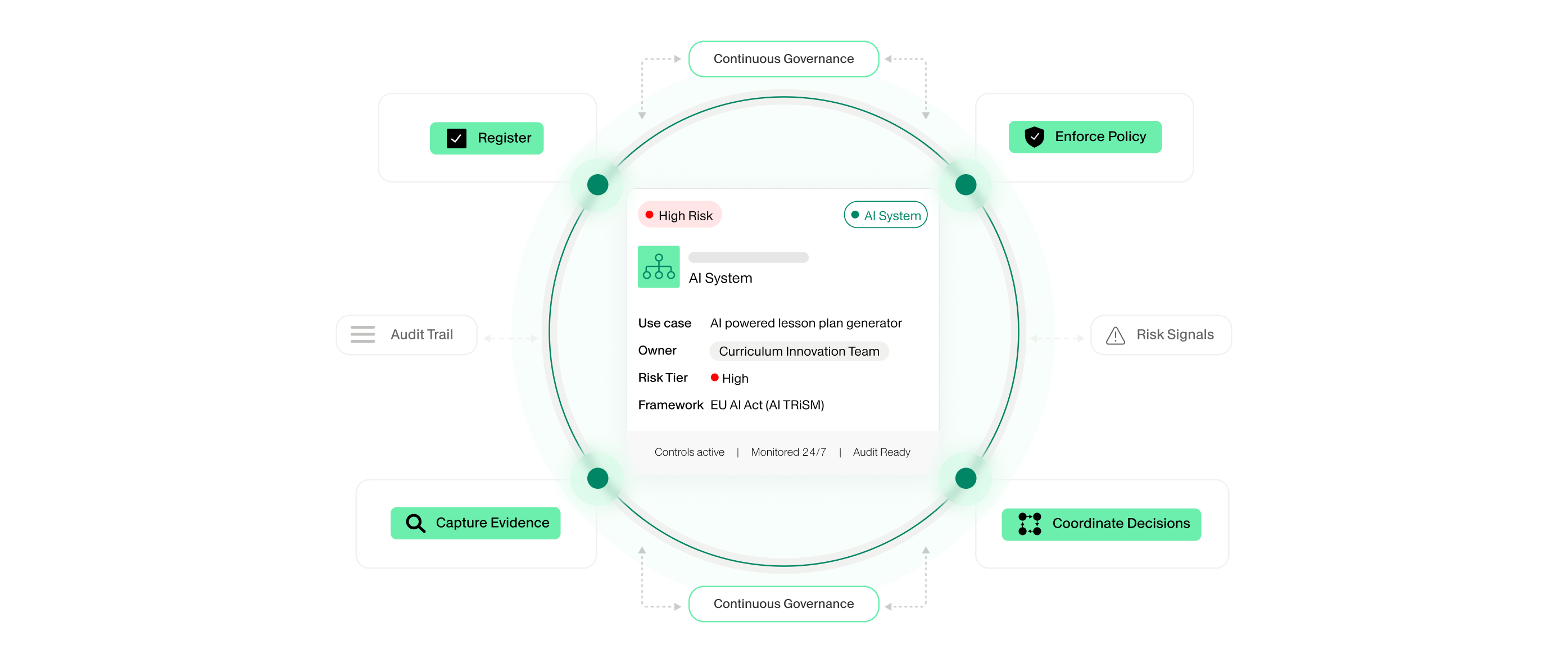
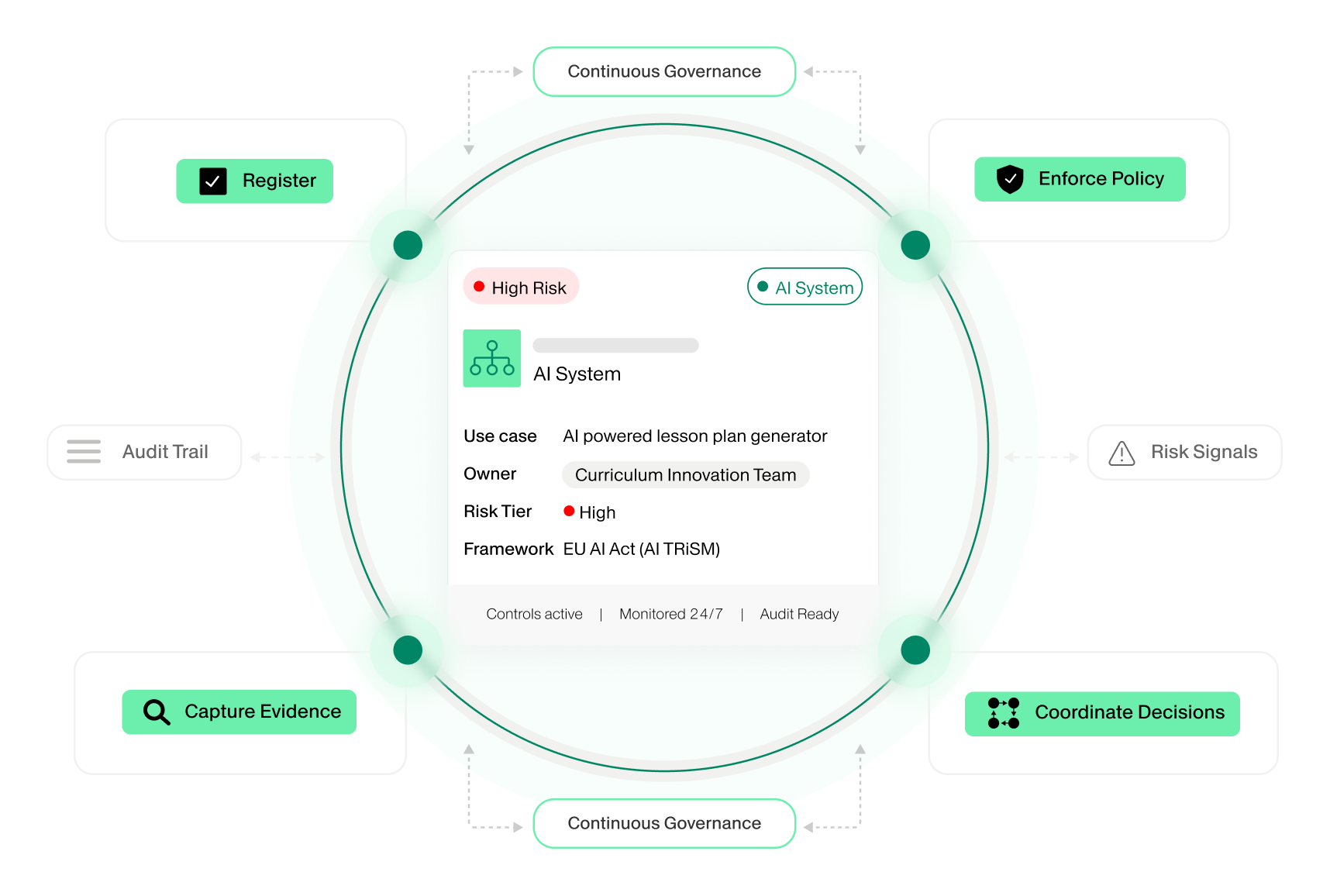
The EU AI Act requires organizations to maintain continuous oversight and control over high‑risk AI systems throughout their lifecycle. OneTrust enables this by providing a system of continuous governance that keeps AI systems under control as they operate in production — registering systems, enforcing policy, coordinating decisions, and producing enforcement‑ready evidence by default.

Operationalize EU AI Act Continuous Monitoring and Enforcement
Shift from point‑in‑time compliance to continuous AI oversight
EU AI Act compliance breaks down when governance stops at approval. OneTrust replaces point‑in‑time compliance with continuous oversight by keeping governance active after AI systems move into production.
OneTrust registers and maintains an always‑current view of AI systems in scope — including models, agents, datasets, and third‑party AI — along with ownership, lifecycle status, and dependencies. As AI systems change, governance scope updates automatically, ensuring oversight does not lag behind deployment reality. This continuous oversight ensures organizations always know which AI systems are subject to EU AI Act obligations, who is accountable, and where governance controls apply.
Implement continuous risk management across the AI lifecycle
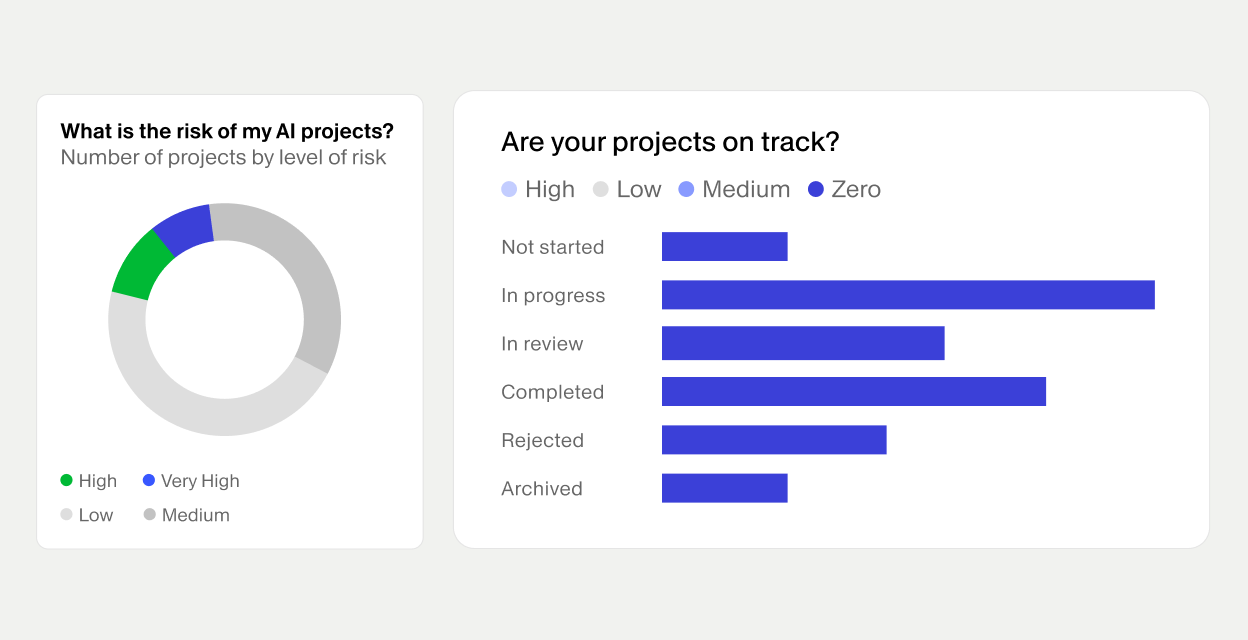
Article 9 requires AI risk management to operate as a continuous process. OneTrust operationalizes this requirement by assessing and streamlining AI risk directly within the governance system that oversees AI in production.
Risk records remain linked to live AI systems and are continuously evaluated as monitoring events, incidents, or material changes occur. When models, data, agents, or usage patterns change, OneTrust automatically re-evaluates and adjusts risk classification. Risk decisions, mitigation actions, and ownership are coordinated across legal, privacy, security, and AI teams through enforceable workflows and documented automatically. This ensures AI risk management remains consistent, accountable, and defensible throughout the AI lifecycle.

Ensure post‑market monitoring
Article 72 requires continuous post‑market monitoring of high‑risk AI systems, with the ability to demonstrate oversight to regulators anytime. OneTrust operationalizes post‑market monitoring by turning runtime signals into governance action.
- Events and incidents are monitored across both internal and third‑party AI systems, classified, and routed through enforceable response workflows.
- Decisions and corrective actions are documented automatically, creating enforcement‑ready evidence as part of normal operations.
Post‑market monitoring becomes continuous governance and control, not disconnected data or manual reporting.
Apply quality management and enforcement readiness
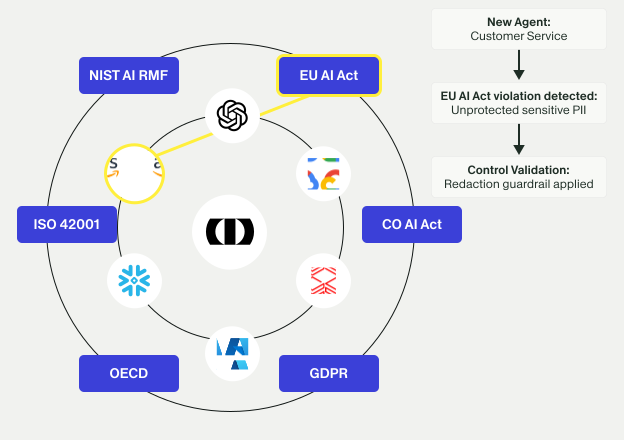
OneTrust embeds AI governance directly into daily workflows to enforce approved use, apply guardrails, and prevent non‑compliant behavior across AI systems and teams. Governance actions generate audit trails automatically, keeping evidence continuously current and regulator‑ready. Organizations can respond to enforcement inquiries with clarity, confidence, and defensible proof of control.
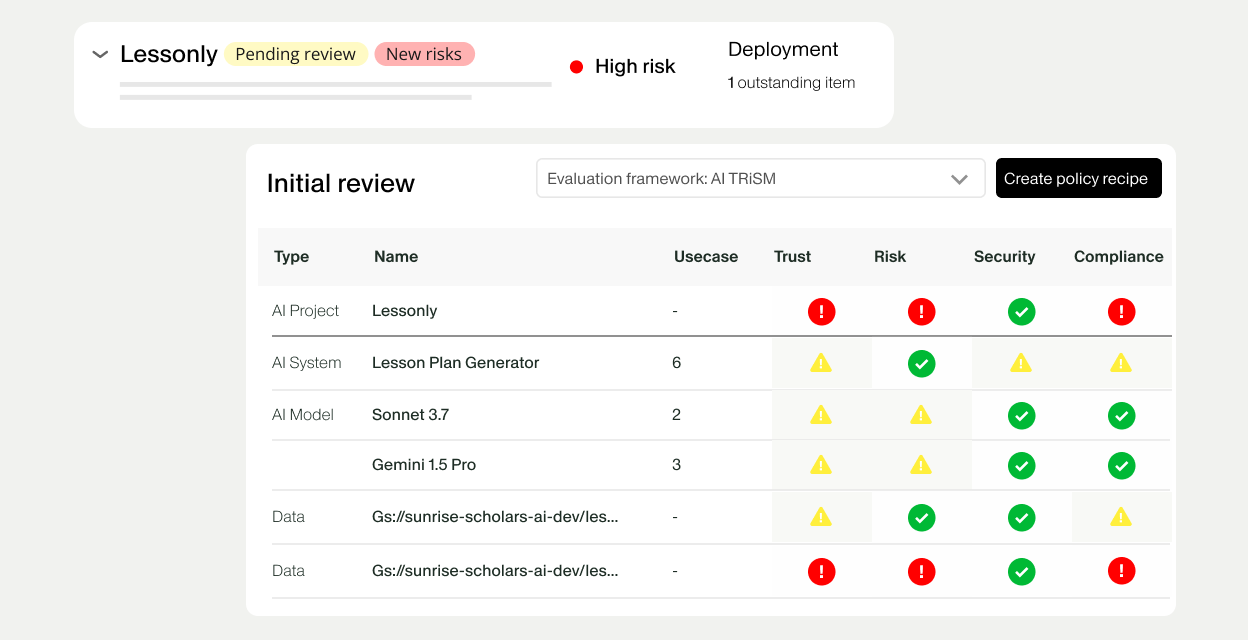
Apply Quality Management and Enforcement Readiness
The EU AI Act rolls out in phases, which started August 2024. Key rules for high-risk and general-purpose AI systems apply between 2025 and 2027, with full compliance expected by 2030 for large-scale infrastructure.


You May Also Like


Frequently Asked Questions
Yes. Articles 9 and 72 require continuous risk management and post‑market monitoring for high‑risk AI systems throughout their lifecycle.
It requires ongoing observation of AI behavior in real‑world use, incident detection, corrective action, and evidence that can be provided to regulators on request.
No. MLOps tools detect technical signals, but they do not enforce governance, document decisions, or generate regulatory evidence. EU AI Act compliance requires governance outcomes.
OneTrust connects monitoring signals to governance execution — turning technical alerts into risk decisions, policy enforcement, incident response, and defensible evidence. It complements MLOps platforms rather than replacing them.
OneTrust unifies AI inventory, risk management, post‑market monitoring, quality management, and enforcement readiness in a single system of continuous governance — enabling consistent oversight across all AI systems.
No. While Article 72 applies directly to providers, deployers also have obligations related to oversight and incident handling. OneTrust supports both across internal and third‑party AI systems.
Operationalize EU AI Act compliance with OneTrust
OneTrust is the AI‑Ready Governance Platform™ that enables organizations to register, assess, monitor, and enforce governance across AI systems — maintaining continuous control throughout the AI lifecycle.